LaneFreeDrive
Modular C++ control-algorithm library for lane-free traffic, built on TrafficFluid-Sim (modified SUMO).
Research software · Lane-free traffic · Connected autonomous vehicles · C++ / Python · TrafficFluid-Sim / SUMO
GitHub repository · Peer-reviewed paper (2025)
Project overview
LaneFreeDrive is a modular library of control algorithms and simulation tools for studying lane-free traffic (LFT), in which connected autonomous vehicles (CAVs) coordinate longitudinal and lateral movements without being constrained to fixed lanes. The library brings different control approaches into a common software structure, facilitating implementation, testing and comparison under configurable traffic scenarios.
The framework runs on TrafficFluid-Sim, a modified version of the microscopic traffic simulator SUMO developed for lane-free traffic. It supports experiments with coordinated CAVs as well as mixed traffic involving human-driven vehicles (HDVs). The 2025 publication demonstrates the framework on a ring road; the library is being extended to other control methods and traffic scenarios.
Simulation integration and modular design
The core vehicle-control methods are implemented in C++ through the TrafficFluid-Sim plug-in interface. At each simulation step, the controller accesses vehicle states and supplies longitudinal and lateral acceleration commands. Python scripts help generate scenarios, configure experiments and run multiple simulations in parallel.
The software separates control logic from experiment setup using reusable components and .ini configuration files. Default settings can be overridden for individual scenarios, making it easier to switch algorithms, tune parameters and compare methods without repeatedly editing the simulation code.
Lane-free control algorithms
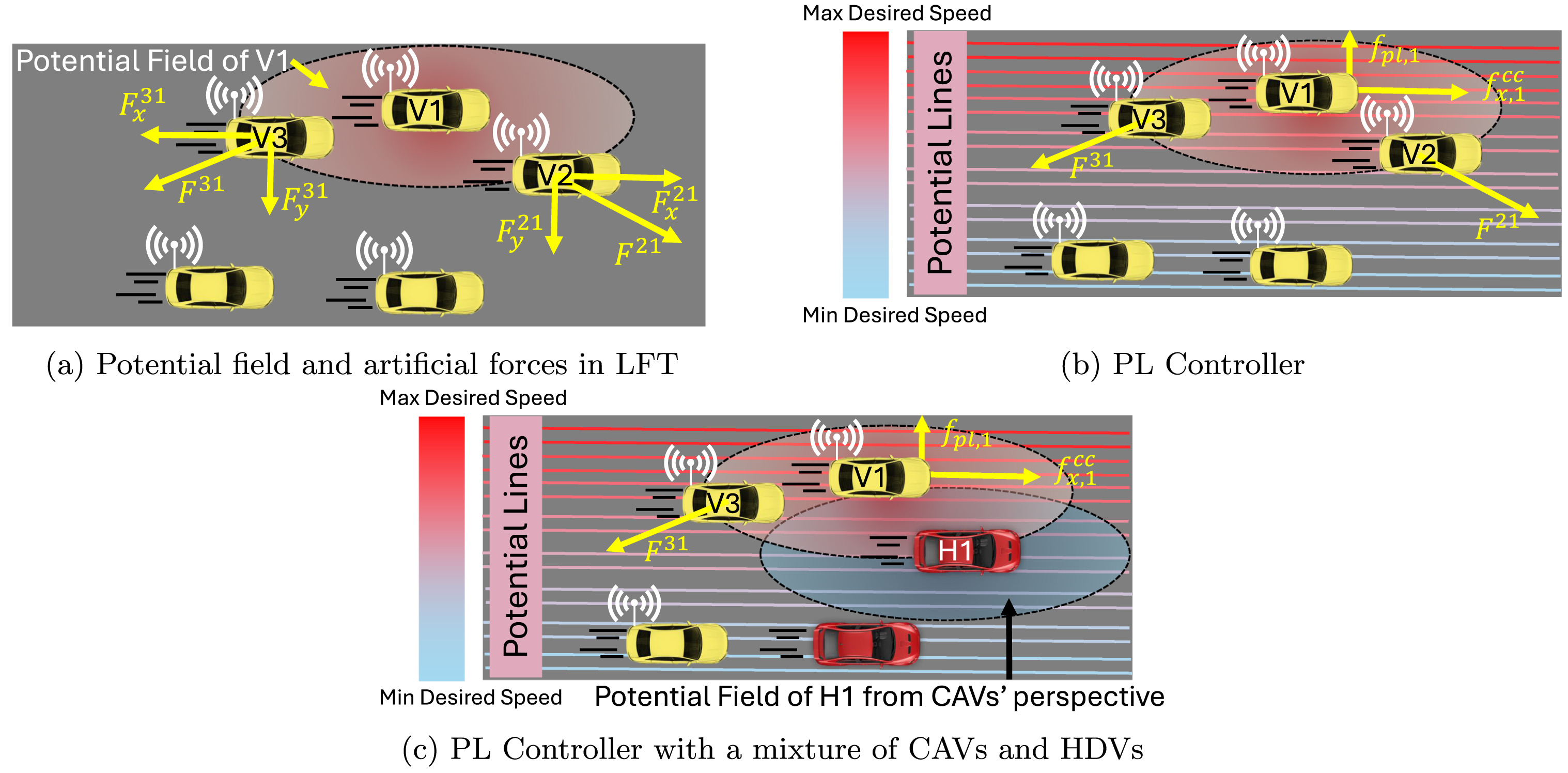
One implemented approach is the Potential Lines (PL) controller, which organizes CAVs laterally according to their desired speeds while using artificial repulsive and nudging forces to coordinate surrounding vehicles. The published implementation also incorporates safe-velocity constraints to reduce collision risks in dense or mixed traffic.
To study the transition from fully connected to mixed traffic, LaneFreeDrive also incorporates a strip-based human-driver model that allows continuous lateral movements. CAVs can coordinate their own movements, while HDVs are modeled as non-connected vehicles that do not respond to artificial CAV control forces.
Adaptive control for mixed traffic
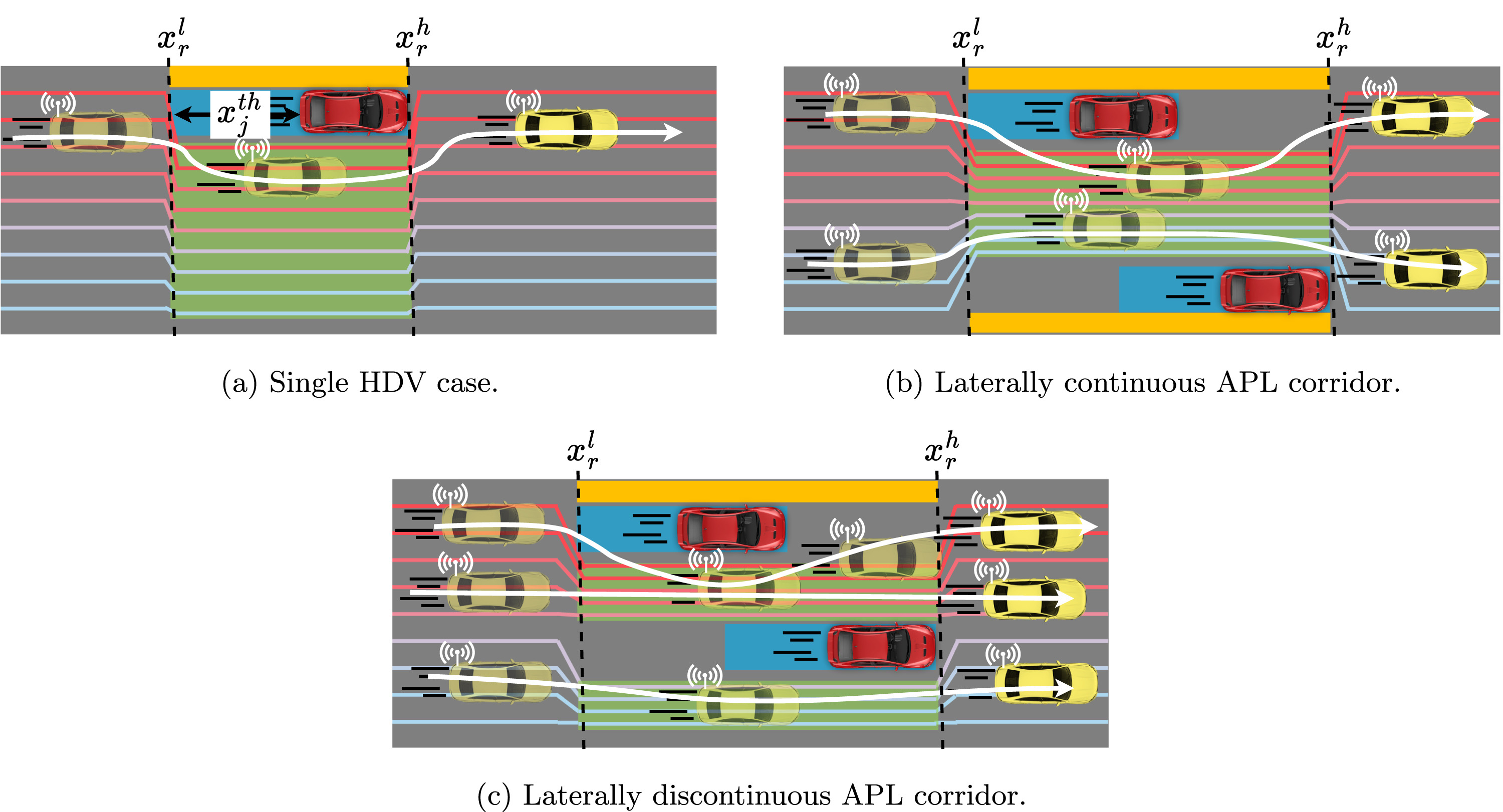
The Adaptive Potential Lines (APL) controller was developed to reduce the restrictions that HDVs impose on CAV movements. It modifies the lateral PL positions near HDVs and creates APL corridors that can help CAVs overtake slower vehicles while maintaining coordinated movement.
The publication evaluates four APL variants with different corridor-activation rules. This illustrates how the library can be used to test alternative control strategies within a shared microscopic simulation setup.
My contributions
At the Technical University of Munich, I developed LaneFreeDrive as a more modular, configurable research framework. My contributions include:
- Redesigning the base TrafficFluidSim plugin with reusable control components.
- Replacing hard-coded control parameters with configuration-driven experiment settings.
- Adding human-driven vehicle behavior for mixed CAV–HDV simulations.
- Developing and evaluating safe-velocity modifications and the Adaptive Potential Lines control approach.
- Supporting systematic simulation experiments and comparative analysis of control strategies.
Example: Mixed Traffic
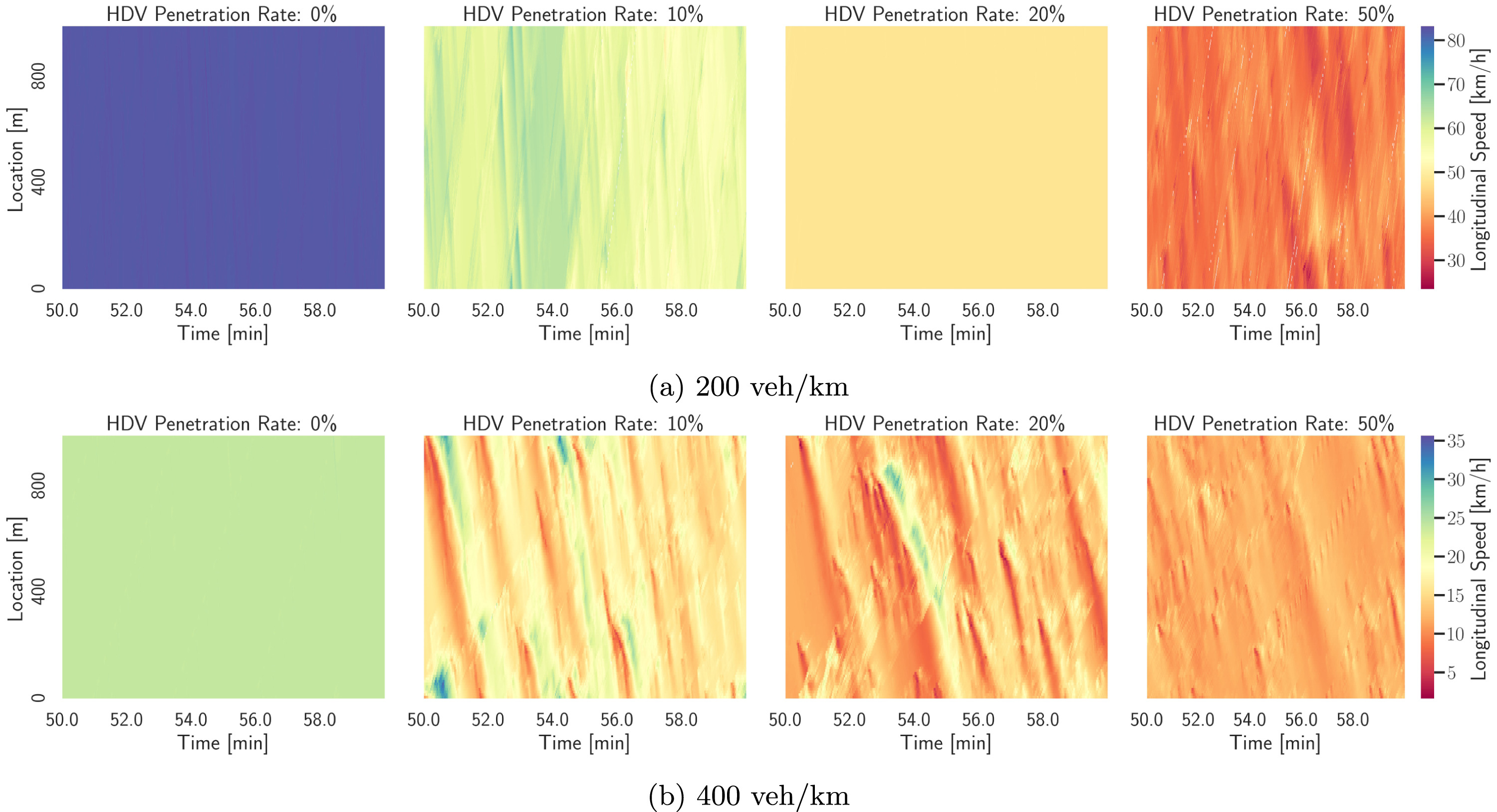
In our 2025 study, LaneFreeDrive was used to compare CAV-only and mixed CAV–HDV traffic on a 1 km ring road. The simulations showed that introducing just 5% HDVs reduced maximum traffic flow by about 20% relative to the all-CAV case. APL strategies improved performance over the baseline PL controller, with a peak average flow improvement of nearly 10% in the evaluated conditions.
These are scenario-specific simulation findings, not predictions for every road network. The ring-road configuration and chosen controller models may influence how strongly traffic disruptions appear.
Ongoing development
LaneFreeDrive is being extended along three research directions:
- Reinforcement learning: learning-based control methods for adapting CAV coordination to different traffic conditions.
- Vehicle flocking: investigating group-level coordination and flocking behavior in lane-free traffic.
- Mixed traffic at ramps: examining CAV–HDV interactions in merging and ramp scenarios beyond the published ring-road setting.
These extensions are in progress and are not presented as results of the 2025 publication.
Code and publication
- Repository: TUM-VT/LaneFreeDrive
- Simulation engine: TrafficFluid-Sim (TU Crete)
- Publication: Syed, A. A., Rostami-Shahrbabaki, M., & Bogenberger, K. (2025). Can human drivers and connected autonomous vehicles co-exist in lane-free traffic? A microscopic simulation perspective. Transportation Research Part C, 180, 105315. DOI: 10.1016/j.trc.2025.105315
Image credits: Figures 3, 4 and 8 extracted from Syed et al. (2025) and reproduced under CC BY 4.0. All figures can be opened at full resolution.