FleetPy
Open-source, modular agent-based simulation for mobility-on-demand services and fleet optimization.
Open-source research software · Mobility-on-demand · Fleet management · Python
Source code · Peer-reviewed paper (2026) · Reproducible study
Overview
FleetPy is an open-source, agent-based simulation framework developed at the Technical University of Munich for mobility-on-demand (MoD) services. It enables researchers to evaluate ride-hailing, ride-pooling, fleet operations and different service designs within a consistent simulation environment. Its modular architecture supports comparisons of algorithms and scenarios without rebuilding the entire simulation for each research question.
Framework architecture
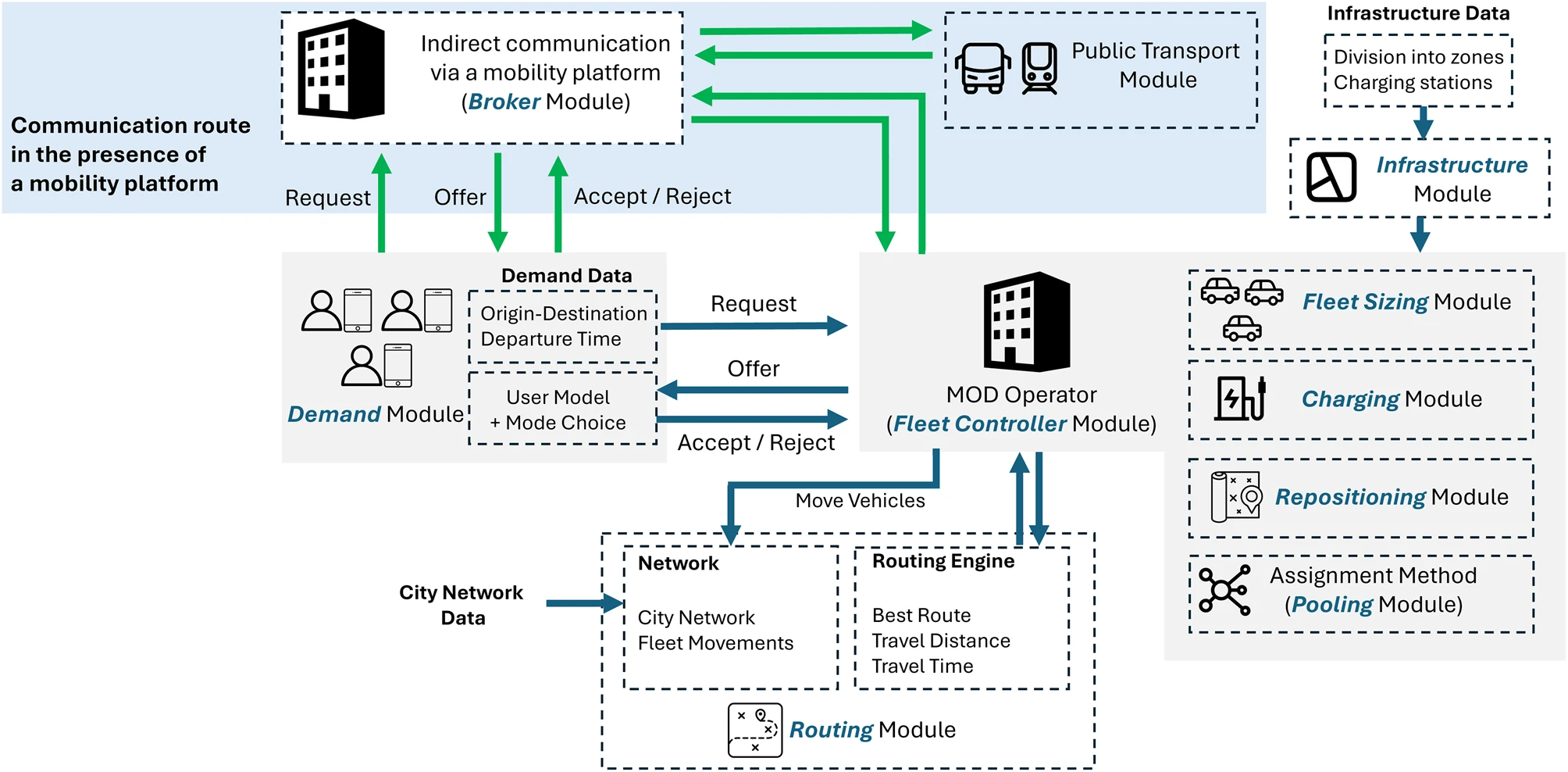
FleetPy separates the main components of an MoD system: customer demand and behavior, street networks and routing, mobility operators, fleet control, public transport, and the interaction between users and providers through a mobility broker. The modules can be configured or extended independently.
This makes it possible to change fleet-control strategies while retaining the same scenario, demand inputs, and routing assumptions. It also lets researchers extend a specific module without replacing the rest of the simulation framework.
Fleet optimization and simulation capabilities
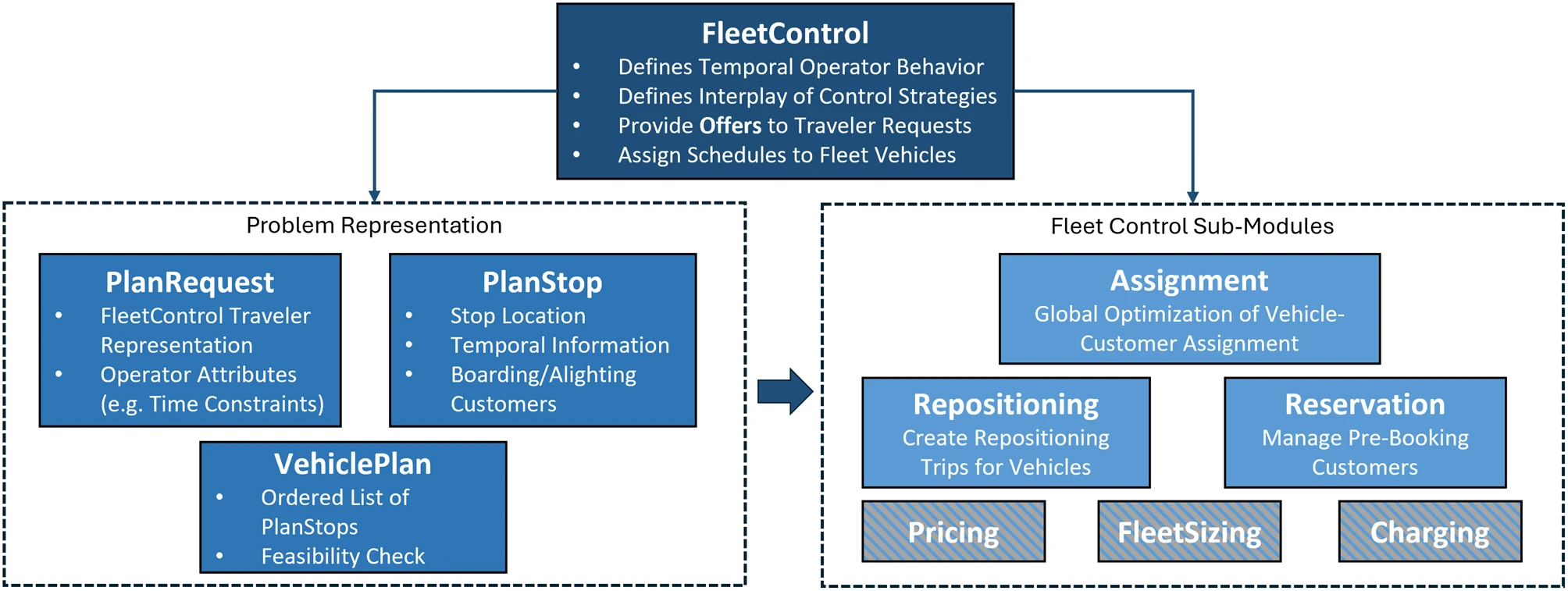
The framework includes interchangeable fleet-control methods for vehicle–request assignment, vehicle repositioning, trip offers and pricing, and charging. It supports immediate-request and batch-offer simulation flows, allowing different operational policies to be evaluated under shared assumptions. Outputs include service rates, waiting and travel times, vehicle occupancy, empty kilometers, operating costs, and other performance indicators.
The modular fleet-control architecture separates operator-level decisions from the underlying simulation. Researchers can compare alternative strategies under common demand and network conditions, helping make the performance differences more interpretable.
My contributions
I was a founding co-developer of FleetPy at TUM. My work included:
- Contributing to the framework’s conceptualization, methodology, and software development.
- Developing and improving demand forecasting, vehicle repositioning, and request-assignment methods for mobility-on-demand services.
- Supporting reusable simulation and optimization workflows used across research projects.
The framework has been used in several TUM research projects. FleetPy is a collaborative project; the paper credits a broader team of contributors.
Reproducibility and case studies
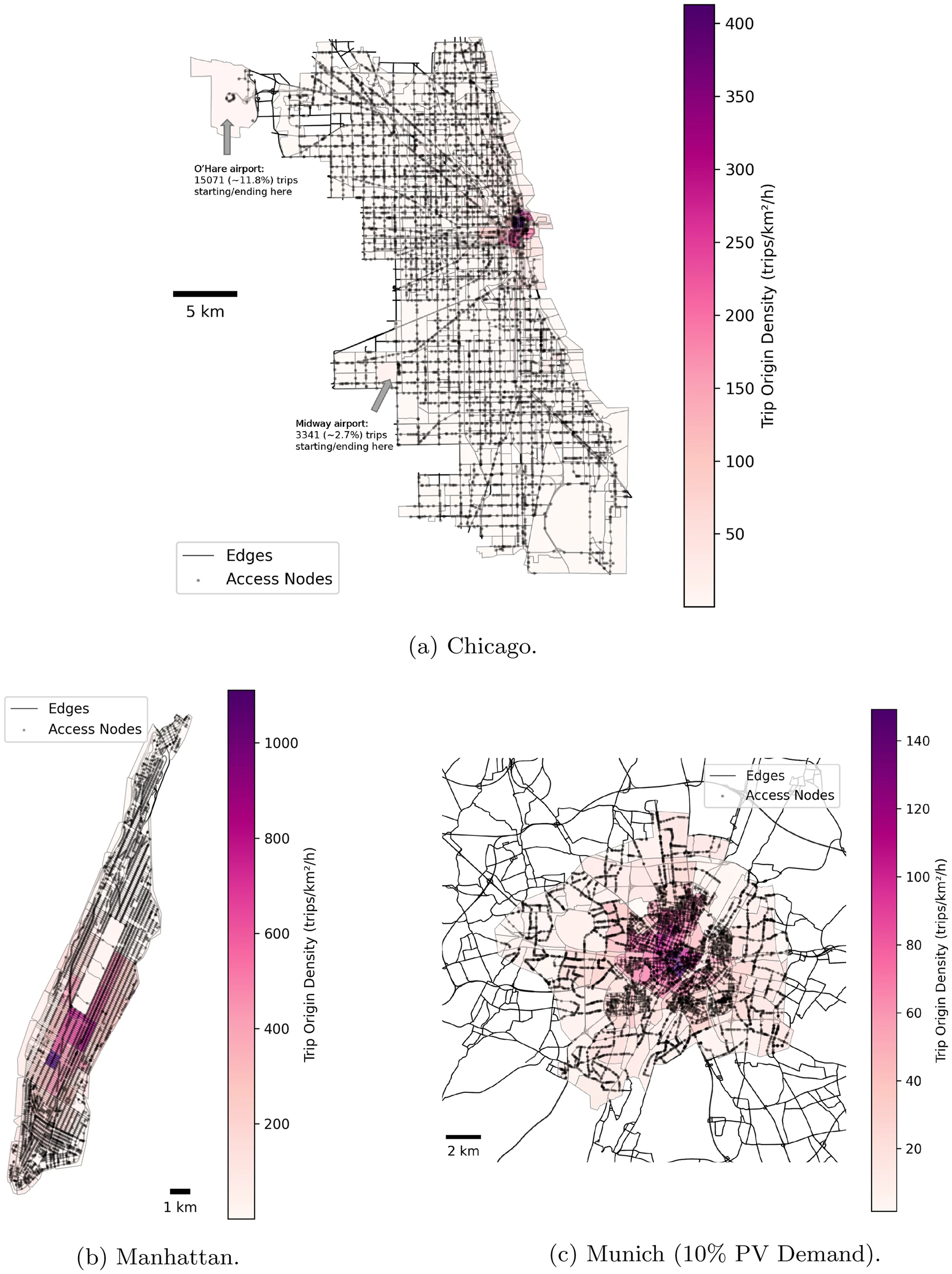
The project provides standardized benchmark datasets for Manhattan, Chicago, and Munich, allowing researchers to test operational strategies in different urban contexts. The 2026 paper illustrates this with an assignment-algorithm comparison and a multi-operator scenario examining trade-offs between ride-hailing and ride-pooling.
The benchmarks support evaluation of simulation and fleet-control strategies across different urban contexts. Linked example configurations and analysis workflows allow others to reproduce and adapt the published experiments.
Links and references
- Code: github.com/TUM-VT/FleetPy
- Paper: Engelhardt, R., Dandl, F., Syed, A. A., et al. (2026). FleetPy: an open source simulator for reproducible research on mobility-on-demand services. European Transport Research Review, 18, 52. DOI: 10.1186/s12544-026-00823-3
- Reproducible study: Example study, configurations and analysis notebook
Image credits: Figures 2, 4 and 6 reproduced unchanged from Engelhardt et al. (2026), published under CC BY 4.0.