SAVeNoW
Funded research on lane-free traffic, human perception and the development of a dynamic driving-simulator test capability.
Funded research · 2021–2023 · Digital twins · Driving simulation · Human-centered automated mobility
SAVeNoW project · TUM project description · Simulator announcement
Project overview
SAVeNoW (Functional and Traffic Safety for Automated and Connected Mobility – Benefits for Society and Ecological Effects) was an industry–academic research project led by Audi and supported by the German Federal Ministry of Transport. The project developed a digital twin of Ingolstadt’s urban traffic for evaluating automated and connected mobility in terms of safety, traffic efficiency, environmental impacts and social acceptance.
At the Technical University of Munich (TUM), a key research direction was lane-free traffic (LFT): exploring whether connected automated vehicles could use road space without conventional lane markings, and how humans would perceive such a traffic system. An important component was establishing a dynamic driving-simulator capability to investigate human responses in scenarios that would be difficult or unsafe to test on public roads.
My contributions
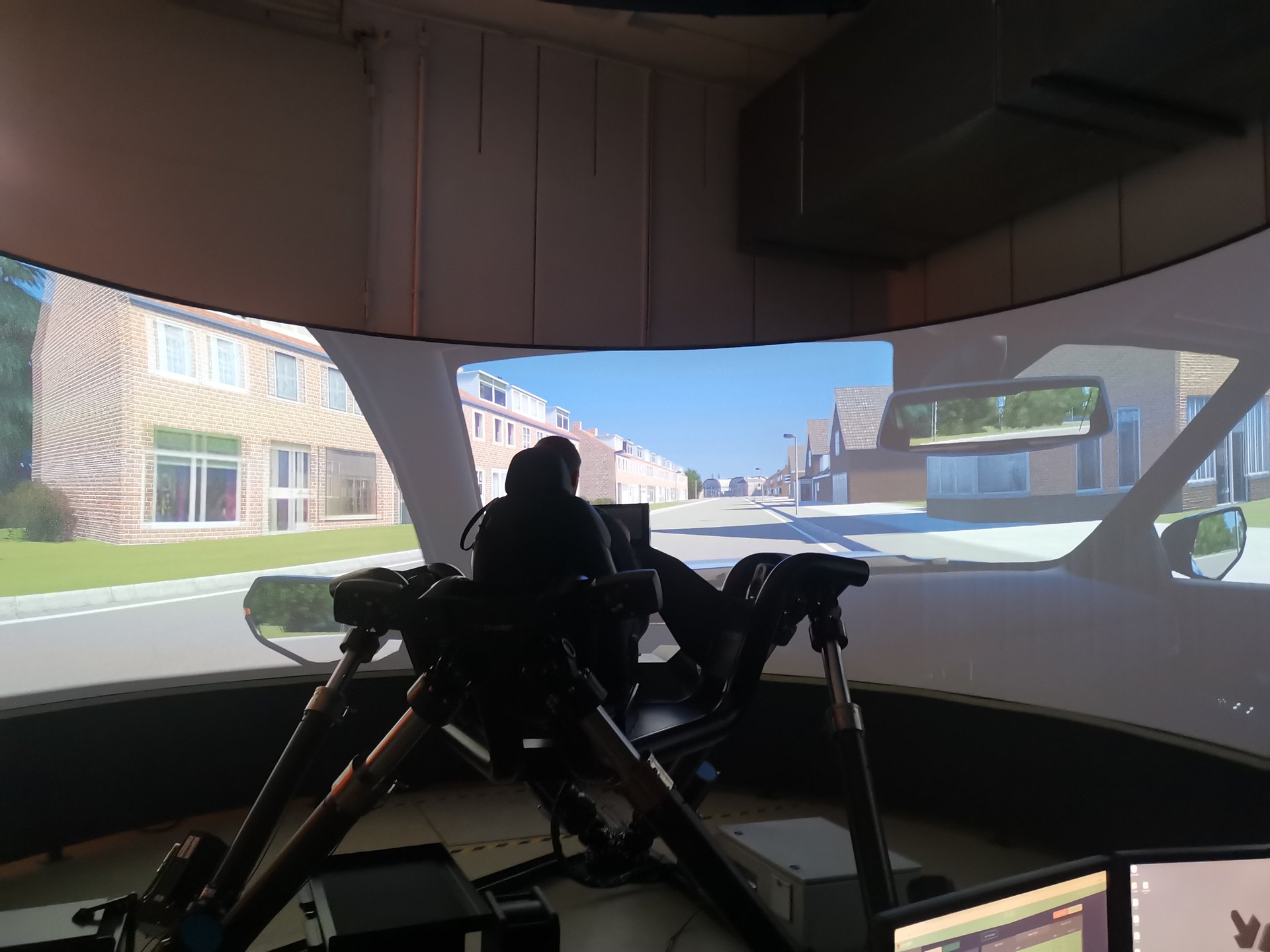
I contributed to TUM’s SAVeNoW activities in two connected areas:
- Research infrastructure: Led the technical procurement process for a Cruden AS2 dynamic driving simulator, including defining technical requirements and specifications, collecting and comparing vendor offers, and developing evaluation and selection criteria. The simulator was installed at TUM in 2023 to support human-centered research on automated and lane-free driving.
- Research methodology: Co-authored a framework for investigating perceived safety, comfort and human acceptance of lane-free traffic using a dynamic driving simulator.
- Experimental design: Helped investigate requirements for simulator hardware, traffic-simulation integration and a structured set of test scenarios ranging from fully automated to mixed human–automated traffic.
How can people experience lane-free traffic safely?
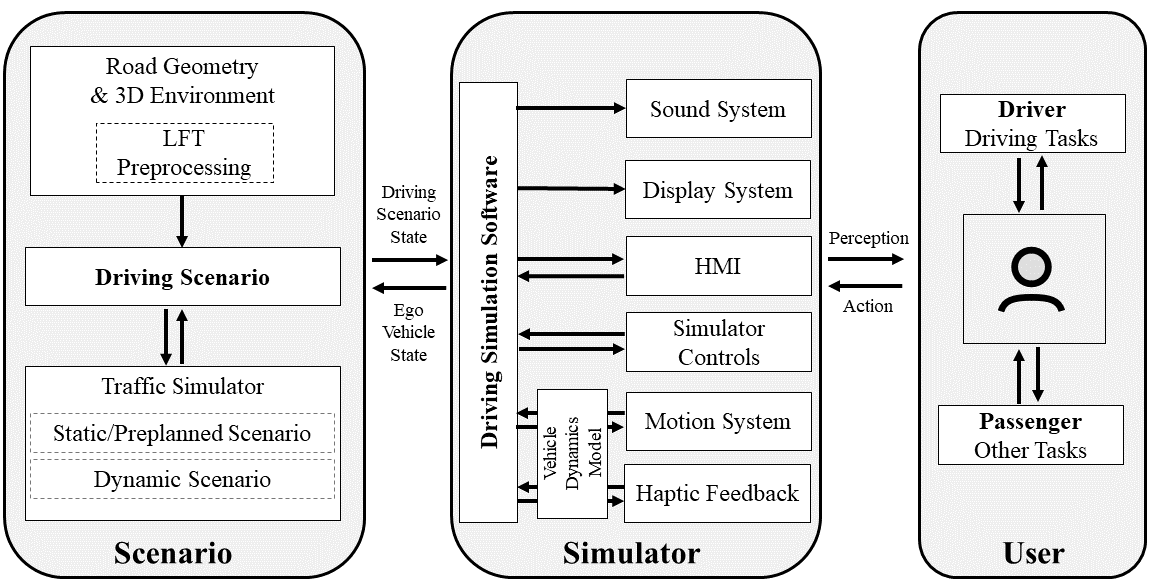
Conventional microscopic traffic simulations can assess capacity and vehicle trajectories, but they cannot directly reveal how a person feels when surrounded by fast-moving vehicles without conventional lanes. The research therefore examined the use of a motion-based simulator to study both drivers and passengers in realistic virtual traffic conditions.
Our 2023 paper proposed a conceptual architecture combining lane-free traffic scenarios with driving-simulation software, vehicle dynamics, displays, sound, motion feedback and human–machine interfaces. Particular emphasis was placed on representing lateral movements, close vehicle spacing, and the transitions between automated and human-controlled driving.
Simulation integration and virtual environments
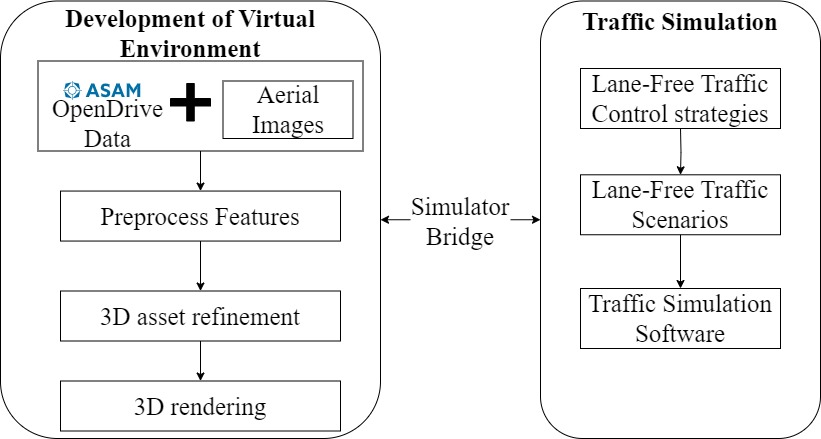
A major technical challenge is connecting microscopic traffic models to immersive 3D driving environments. Traditional road-network formats, such as OpenDRIVE, describe lane-based roads, so lane-free experiments require preprocessing and adjustments to both traffic movements and visual road geometry.
We proposed a modular workflow connecting road descriptions and virtual-environment generation with LFT control strategies and traffic simulation. For scenarios involving a human-driven ego vehicle, the paper highlights the need for bidirectional exchange: surrounding simulated vehicles must respond to the human driver’s actions in real time.
Research scenarios and human perception
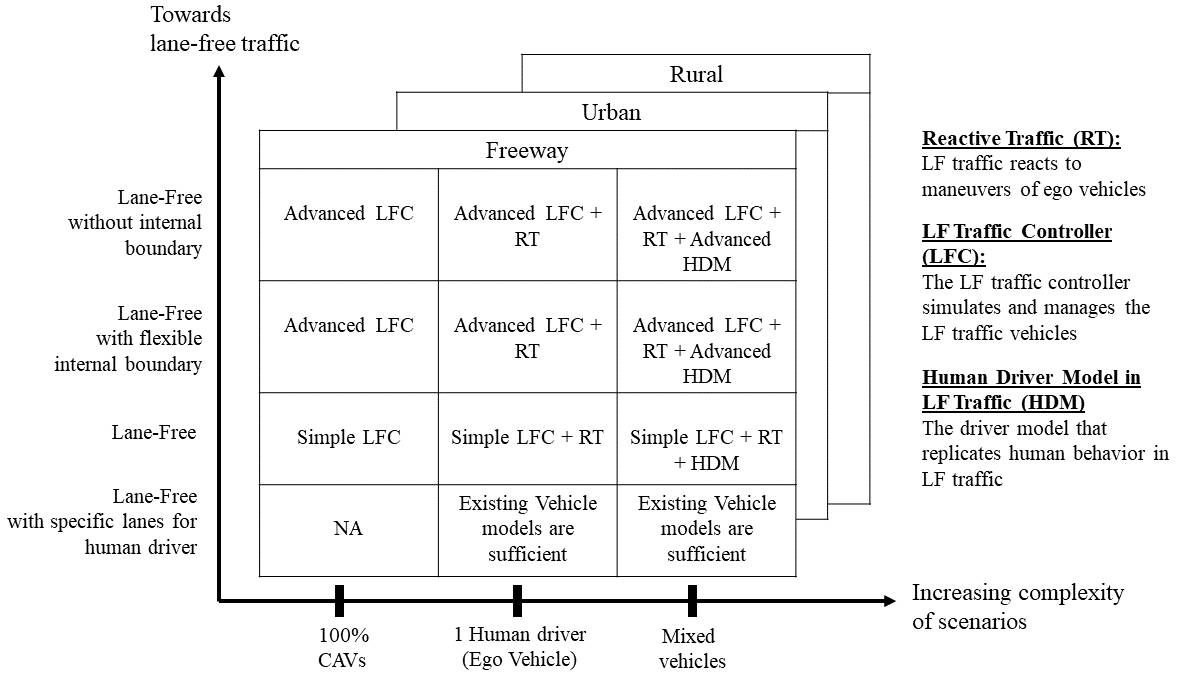
We introduced a scenario matrix that organizes possible studies by levels of vehicle automation, human involvement and complexity of lane-free traffic control. It ranges from automated-vehicle passenger experiences to a human-driven ego vehicle interacting with reactive LFT, and eventually more complex mixed traffic.
The proposed research questions include whether smaller lateral and longitudinal gaps affect perceived safety, how vehicle motion cues influence comfort, and whether human–machine interfaces can improve understanding and trust. The paper discusses eye tracking, physiological sensing and surveys as possible methods of assessment, not as measurements already collected.
Publications and project links
- Sekeran, M., Syed, A. A., Lindner, J., Margreiter, M., & Bogenberger, K. (2023). Investigating Lane-Free Traffic with a Dynamic Driving Simulator. IEEE ITSC. DOI — conceptual framework and scenario matrix; acknowledges SAVeNoW funding.
- Sekeran, M., Rostami-Shahrbabaki, M., Syed, A. A., Margreiter, M., & Bogenberger, K. (2022). Lane-Free Traffic: History and State of the Art. IEEE ITSC. DOI — supporting scientific background; the paper acknowledges a separate DFG project.
- SAVeNoW official website · TUM’s SAVeNoW subproject · Cruden’s simulator announcement · Mobility Innovation Campus
Project context: March 2021–June 2023; coordinator: Audi AG; total consortium budget: €10.75 million, including €7.71 million federal funding (German transport ministry). These are consortium-wide figures, not a budget personally managed by me.
Figure credits: The simulator photograph and Figs. 1, 3 and 4 are extracted from Sekeran et al. (2023), IEEE ITSC, DOI: 10.1109/ITSC57777.2023.10421947. © 2023 IEEE.